
Crude Reality, Calm Perspective
I hope you’ve been well since my last letter and are enjoying the deceptive peeks of spring weather (for those of you here in the Midwest).
I try to avoid rehashing current events in these articles since they get enough news coverage as is, but I’d be remiss not to touch on the war with Iran and the closure of the Strait of Hormuz, which have pushed oil prices higher and led to increased market volatility.
I want to walk through a few points using the charts below to help put this into perspective.
Oil shocks rarely leave long-term damage
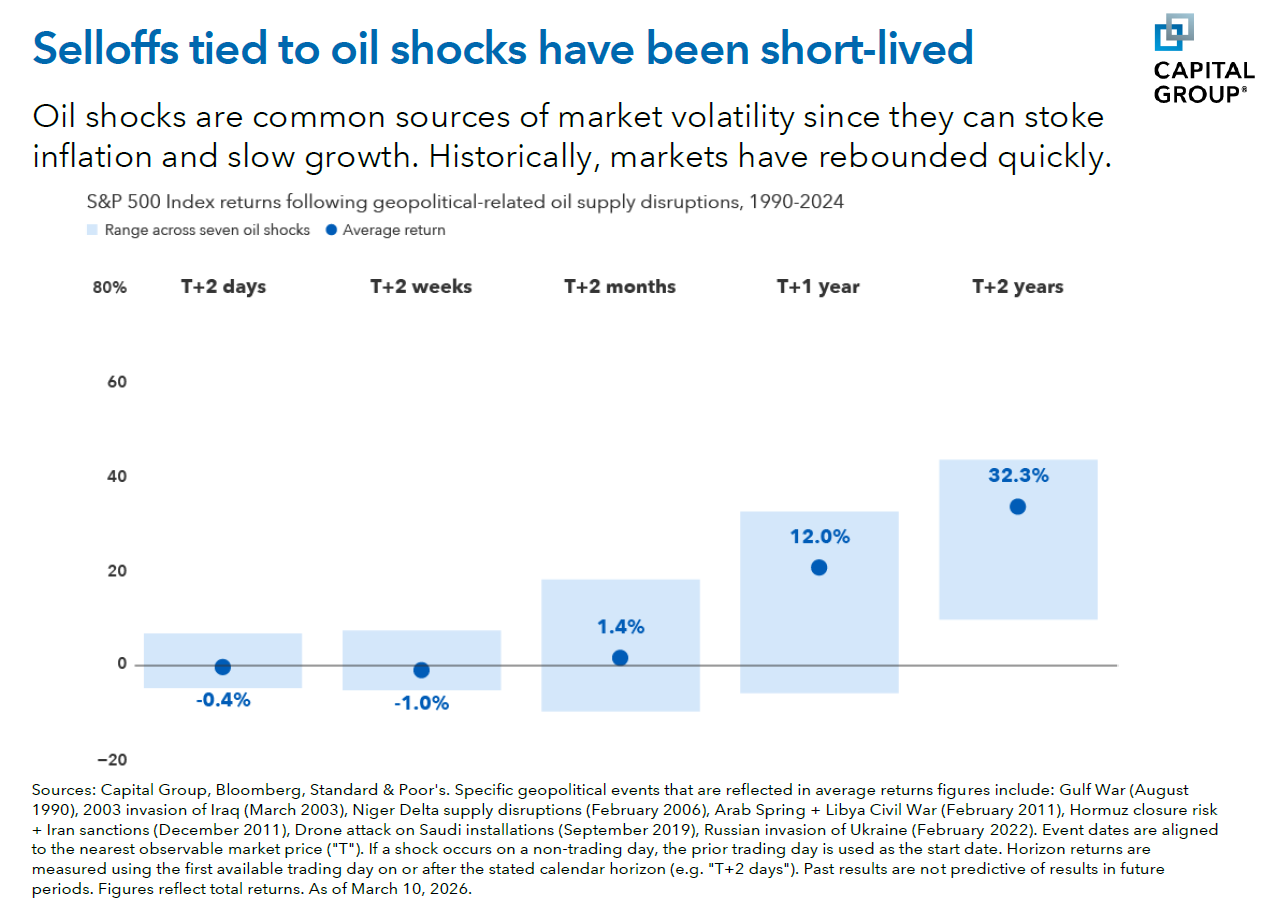
First, I want to reassure you. Several clients have asked whether the war and subsequent rise in oil prices will plunge the U.S. into a recession. While that is always a possibility, similar events in the past have not had a lasting negative impact on stock returns or the economy. The chart above shows how the stock market, represented by the S&P 500, has responded to major oil supply disruptions over the past few decades.
While each situation is different, the pattern is relatively consistent. Markets often react negatively in the short term, but those declines have historically been followed by decent returns over the next 1–2 years [i].
Just like most humans, the stock market (comprised of humans) doesn’t like surprises. However, once investors have time to get their bearings and the initial uncertainty fades, prices usually stabilize. The higher energy costs might stick around for a while, but the market tends to move forward.
Today’s energy landscape is very different

Now it’s time for a fun fact. It may surprise you that the United States has become the world's largest producer of oil and natural gas [ii], and it’s not even close. This strong domestic production helps insulate us from oil supply shocks such as the one we’re experiencing right now.
Our energy supply is far more resilient than it was 20 years ago when disruptions in the Middle East had a more direct and severe impact on the U.S. economy. Today, that impact is generally more contained.
Gas prices will probably rise for the foreseeable future, but unless we see a prolonged disruption in global oil supply, history and our position as the top oil producer suggest that the economic impact could be more limited than people fear.
Volatility can create opportunity
Whenever things get messy, it’s important as wise investors to see through the smoke and look for opportunities. Thankfully, the recent market declines aren’t due to a deterioration in the fundamentals that have driven strong growth over the past two years. The foundation for growth is still in place, and I believe these same factors will drive further growth.
They include:
Continued innovation and productivity gains (especially around AI)
Solid corporate earnings
A generally supportive economic and regulatory backdrop
For those of you still in the accumulation phase, times like these are a great opportunity to invest at more attractive prices.
If you’re in retirement and taking withdrawals, this is exactly why we structure portfolios with a “safer bucket” that contains several years of distributions. This allows us to avoid “locking in losses” and selling stocks while they’re down. Remember that the only prices that really matter are the price you buy at and the price you sell at. Everything in between is just noise.
Final thoughts
I want to reassure you that situations like this are not new, and markets have worked through them many times before. Your portfolio is built to withstand this type of environment, even if we see some moderate short-term losses.
As always, if you have questions or want to talk through anything, I’m here to help.
Have a blessed Holy Week and a very happy Easter!
Will Odland, CFP®, CKA®
Founder, Financial Advisor
[i] “Selloffs tied to oil shocks have been short-lived” (Capital Group, March 10, 2026)
[ii] “The U.S. is the world’s top oil and gas producer” (Capital Group, March 10, 2026)
This communication is provided for informational and educational purposes only and should not be construed as personalized investment, tax, or financial advice. Past performance is not indicative of future results. Any forward-looking statements or expectations are based on current assumptions and are not guarantees of future outcomes. Indexes such as the S&P 500 are unmanaged and cannot be invested in directly.